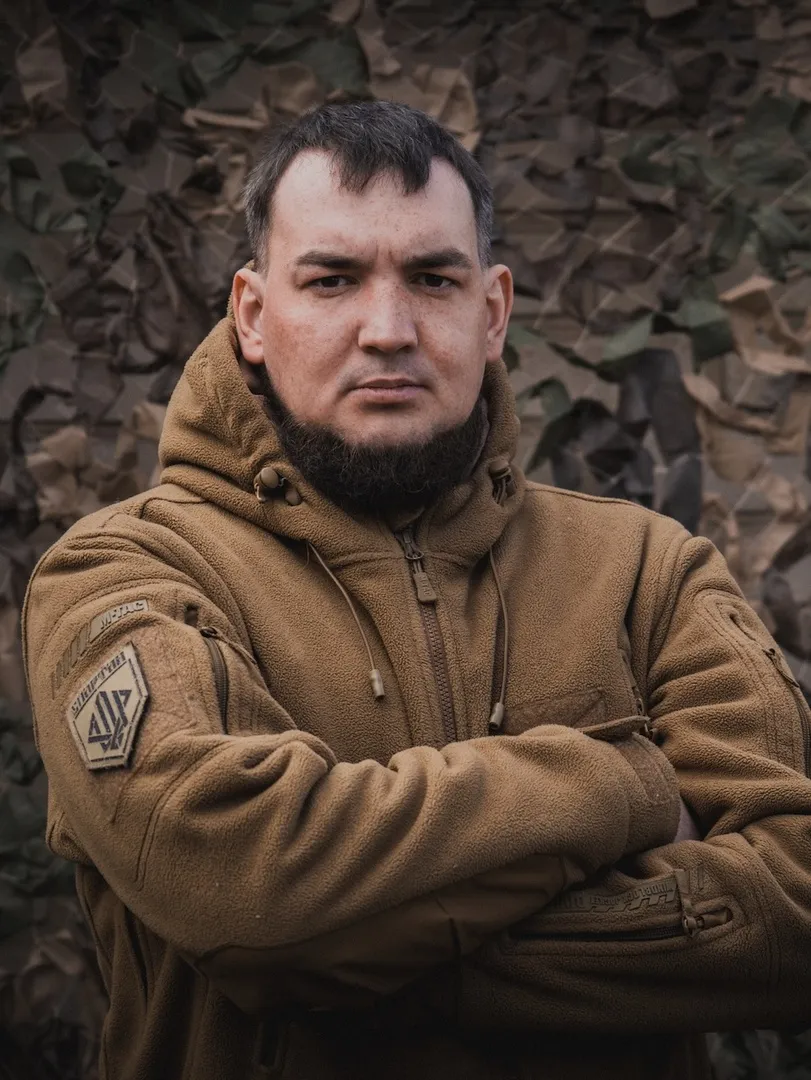
Khotabych
Spartan Brigade fighter Yurii, callsign “Khotabych,” is 29 years old. He is originally from Kryvyi Rih, where he witnessed the beginning of the full-scale invasion. Over more than four years of service, he has carried out various combat missions: he served in a mobile fire group hunting down Shahed drones and missiles, later fought in the infantry, and is now mastering UAV operations.
Khotabych transferred to the Spartan Brigade in September 2025. It was there that he became an infantryman.
How an Infantryman Endures
Khotabych has gone through a wide range of combat missions and knows well what helps an infantryman endure in war. He speaks from personal experience about trust between brothers-in-arms, the strength of the infantry, and the things that save lives on the front line.
“First of all, an infantryman must be mentally resilient. I went on missions as a group leader, so I know that the survival of the entire group depends on the resilience of every single fighter. During combat operations, there is no room for panic or freezing up — we work calmly and support one another,” Yurii noted.
He emphasizes that it is important for infantrymen to support each other, as they say, to lend a brotherly shoulder, because in the trenches you are family and must help one another.
“Physical endurance is also essential. When we head to a position, we carry an average of 18 kilograms on us: body armor, a helmet, weapons, a backpack with ammunition, supplies, and spare clothes. With all of this, we have to walk several kilometers, sometimes run, and at times lie low and wait it out. Sometimes for several days,” Khotabych explains.
In modern warfare, it would be incredibly difficult for infantry units without the support of drone operators.
“The ‘birds’ accompany us, scout ahead to detect possible enemy ambushes and warn us about them, and they are also the first to strike the enemy. Right now, our drones eliminate Russian infantry a kilometer away from our positions. And of course, there is logistics: they drop off supplies and little ‘care packages’ on request — power banks, sweets, medicine, cigarettes,” the soldier emphasizes.
About Motivation
Khotabych recalls that in 2022–2023 there was intense close combat, when you would go “man against man,” whereas now it has become a war of technologies.
“But we’re not fools either, and we know how to fight. That’s why we came back from the mission, while the enemy was far less fortunate. We had one Russian soldier who signed a contract on February 7, and by the 19th, thanks to our work, he had become a ‘200,’” Yurii recalls.
Khotabych also spoke about the small joys that help soldiers recover not only physically, but psychologically as well. The infantryman remembered that after one of the missions, all he wanted was a Fanta and a Snickers.
“So as soon as the doctors examined us and gave us the okay, we went to the store for sweets. There’s a stereotype in society that infantry service is a one-way road. That’s not true. If you go into a mission with that mindset, nothing good will come of it. Whether you’re an infantryman, a UAV operator, or a mortar operator — focus on the job and think about the people you’ll return to. I always know that I have to come back to my wife, my daughters, and my parents. That is the main motivation,” the soldier emphasized.