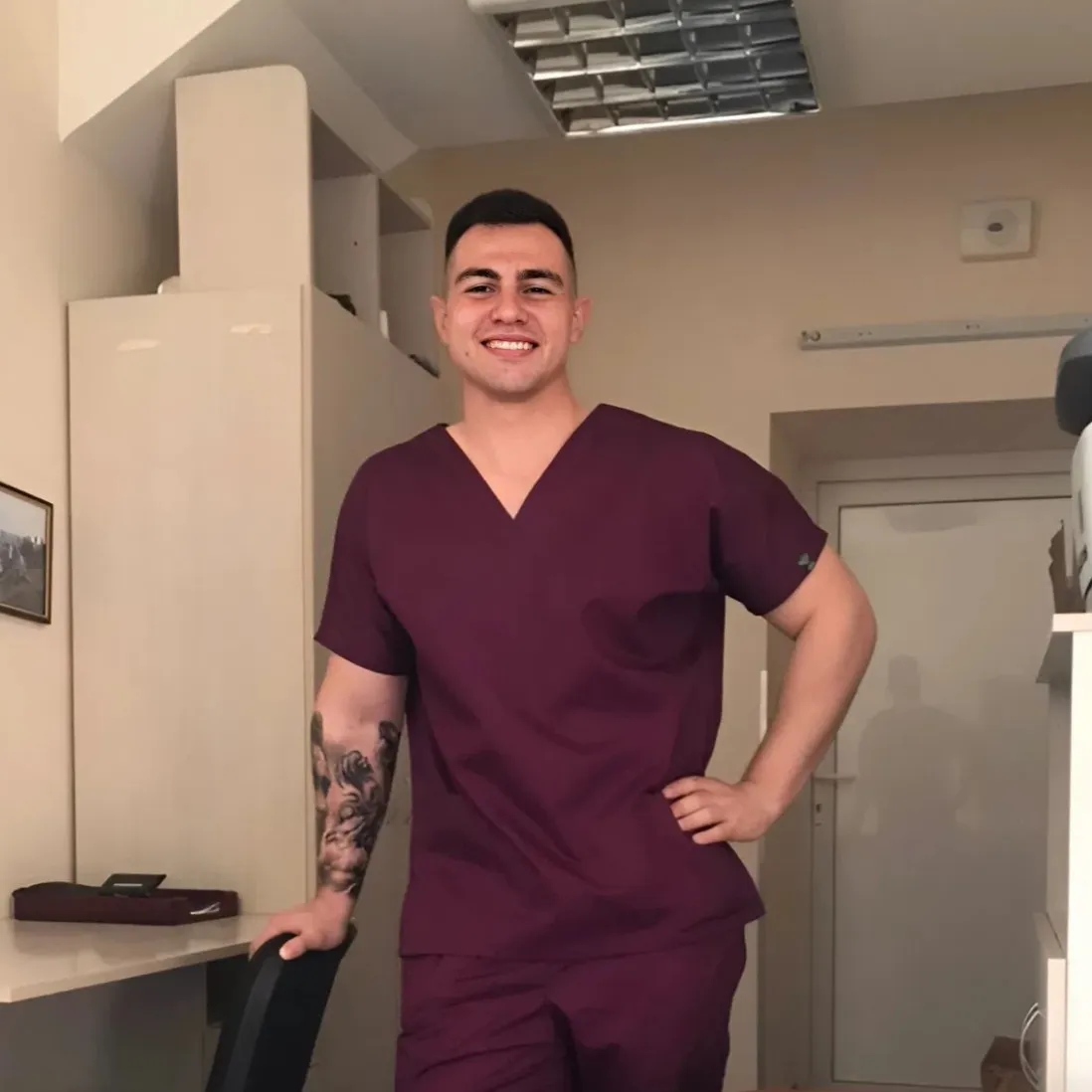
Lyuty
Nikita "Lyuty" - Senior Lieutenant of the Medical Company of the 3rd Operational Brigade "Spartan" named after Colonel Peter Bolbochan. A man who at the beginning of the invasion served in the Kiev Theater, and now every day saves fighters at the stabilization station near Pokrovsk.
Prior to the start of full-scale invasion "February" worked as an anesthesiologist in Kiev. Within a month he had joined the army.
Start of Service
"In 2022, I wanted to be something useful and use my skills for the good of the country to help the boys. My hospital was one of the first to receive the wounded. That's when Irpin and Bucha were on everyone's lips. I saw it all.
First, anger on the aggressor just sprayed.
Secondly, I really wanted to contribute. I understood that most likely I would be able to help in the army a little more than in a hospital in Kyiv," the medic says about the beginning of his journey.
According to him, his first place of service was the Kiev division of TRO.
"I ran with them a little into the floor. Then I know suggested to go to the 27th brigade. With them he fought a little near Kiev, and in the Donbas.
If you know, General Kulchytskyi Battalion, they were together with them on rotation. Later he heard of the medical company. She was still in Eastern TRC. I tried everything I could to get across there. After all, I was put on the position in the headquarters of the battalion and was overthrown with paper wheels. This was clearly not what I expected," - said "February".
The boy was transferred to the "Spartan" brigade in 2023.
Work on the article point
"February" notes that the changes at the checkpoint are quite long.
"This can be a week, 15 days, 16 days, depending on the load. Now we have a stabilization station with other teams, but the main role is played by our team.
It is our specialists who mostly deal with serious wounded. This is the transportation carried out by our anesthesiologists, including me. The alternation begins as follows: I arrived, I was given a change, I overlooked the equipment, asked for drugs, on the remains, to understand what you can, let's say, count on during the day, during the alternation, and what you need to order. Next, wait for the wounded.
As for the wounded, we can be warned that they carry, for example, heavy or medium-sized, and the number accordingly, or may not warn, directly on the armor to come. So we do a quick look around. Next, we either undress or cut off the clothes, looking from the condition, we transfer either to the operating table or to the tables where we are engaged in light wounds. Then we either operate or tie it up like that, or if there are any fractures, we fix, anesthetize and do everything we need. Well, that is how this day passes," admits Nikita.
According to him, the main work takes place in the evening or at night. This is due to the hours that are better suited for evacuation.
More training
"February" says that doctors are constantly gaining new knowledge and improving their skills.
"The only thing is that we find courses for ourselves, take a business trip. For example, I recently went to Kiev, attended courses on bronchoscopy. I believe that such courses are cool.
Plus, now surgeons and anesthesiologists this summer will be sent alternately to the courses on specialized provision of care to the injured. There is such an American system, ITLS (International Trauma Life Support))called. These are advanced assistance skills. That's cool. Foreign experts will teach us. In principle, in such training, I see the point.
Because reading books is good, and practicing them according to the rules of the protocol is different," the medic emphasizes.
The ITLS system is designed to train medical workers, emergency services staff and other specialists with knowledge and skills to provide trauma care at the pre-hospital stage. ITLS is a globally recognized certification that helps health professionals quickly evaluate and treat injured patients.
The hardest part is on duty
"February" admits that the most difficult during duty is when several heavy wounded soldiers are brought at the same time.
"At the same time comes from two or more heavy, then you have to sort very well. Together with colleagues-surgeons we work on this. I, as a doctor, before the war and blood, and the gut saw. My psyche was a little prepared for this.
Plus, the fourth year is coming, we do our job. Mentally you ask, I'm not very pleased when I see young guys 18-19 years old with invalids. I understand how this happens in the future.
I know everything that is done in the next stages of evacuation in the hospital, in hospitals. I understand that his struggle in fact is just beginning," the doctor emphasizes.
In general, doctors fight for the life of the military until the last.
"February" gave an example of a seriously wounded military man who had simultaneous bleeding from the artery and vein.
"Translated, launched the heart and started to work. There was nodular bleeding in the groin area. We resuscitated it. He was more or less adequate neurologically.